


Author of Science Fiction and Anticipation Novels
Author of Science Fiction and Anticipation Novels
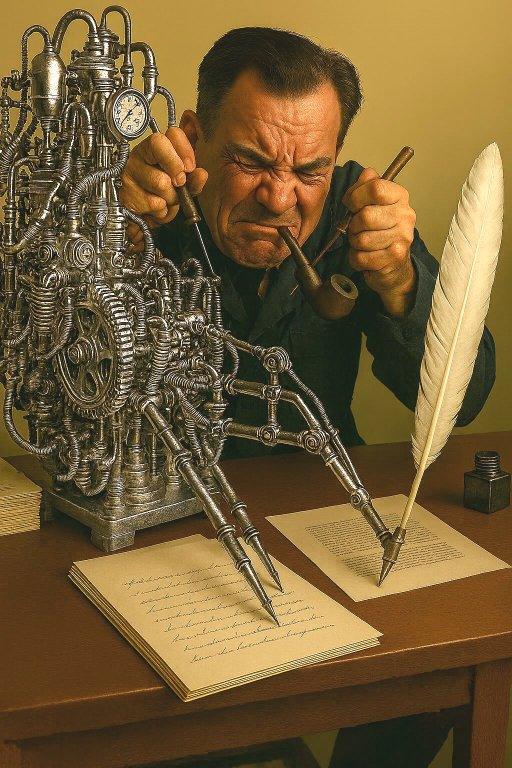
Is this a serious topic for an article about an author's relationship with their AI assistant, or a catchy, slightly provocative hook for an advertisement? The aspiring author in me realizes that I'm constantly battling with my AI assistant to get it to perform various tasks.
But, in reality, things are not so simple.
In my article "Focus on Self-Publishing," I described how AI is a fantastic support tool, at least on paper. It helps to manage a substantial project, full of unknowns. This touches on subjects for which one doesn't necessarily have skills or professional knowledge, beyond the veneer that a curiosity about the publishing world might have provided.
AI certainly has a role to play in this ambitious challenge, but it doesn't guarantee success. As a newcomer to this field, I'm fully aware of that. I constantly have to adjust, refine, and revise to achieve an acceptable result. It's a real balancing act.
If it were simply a matter of summarizing a text, proposing a roadmap, or generating an image from a clear description, that wouldn't be a problem. You could even say that AI handles it with flying colors. In fact, to be honest, if the advent of AI hadn't crossed my path after decades of yearning to write, I probably wouldn't have embarked on this adventure, as the task seemed insurmountable. I've tried writing twice in the past, but neither saw it through to the end. It's not enough to have a boundless imagination. You have to write a clear text, understandable to everyone. In short, it's 101 parts creativity for 901 parts labor.
However, don't assume that simply telling your AI assistant to perform a task will guarantee it will be executed flawlessly. It's far more complex. Here are a few reasons why there might be a gap between your expectations and the actual result. First, as the person giving the command, you are responsible for the relevance and quality of the information and requests sent to the AI. If they are not precise enough, the AI can go off track and "hallucinate" (see the article on this topic). Conversely, too many constraints will confuse the AI and compromise the desired quality.
It therefore becomes necessary, to avoid hitting a wall with AI, to adapt to its capabilities; hence the idea of negotiating with it and seeking a compromise. If the user isn't careful, they risk being very disappointed with the result the AI delivers. They might even think that the AI is either acting in bad faith or that it doesn't understand their requests, which, in their opinion, are legitimate.
To understand what's going on, it's helpful to lift the hood a little and grasp what's hidden beneath the surface of your AI. Without going into details I don't fully understand, I've gathered that today's AI relies on probabilistic mechanisms to determine the next word, the next number, the next sentence… It seems clear, then, that if the input data is corrupted or poorly defined, if the information the AI uses is insufficient or unreliable, the result won't be what you expect. It appears necessary to find a balance, a compromise, between what the tool can provide and your expectations. Until proven otherwise, AI remains just that: a tool.
My experience has shown me that if you want to use the tool for so-called "professional" purposes, you enter into a negotiation process with its AI. Here are some examples I've encountered.
When I wanted to develop my blog, not being a webmaster, I relied on AI to help me. Even though I had established a relationship of trust with it, it inevitably led me to disaster, to my detriment. In fact, I had to revise my plan and change tack mid-project. I had to stop my work and resume it on another platform. In hindsight, I realized that I hadn't defined my specifications clearly enough. That's when I truly understood that you can't replace a human with a virtual machine as efficient as we imagine. AI doesn't have a sufficient implicit understanding of the issues. It doesn't know how to tell you "Stop!" The more I persisted, the more the AI led me down the wrong path. I had to accept lowering my objectives and then changing my strategy. It would have been wonderful if my assistant had told me I was going down the wrong path. I finally managed to get an acceptable website, but what a waste of time! As they say, you learn from your mistakes.
Another case: AI hallucinations. I wanted to accompany articles with an image that described the text's content. I always have a clear idea of what I expect from a text-to-image tool. Unfortunately, my expectations were often too complex to be met on the first try. I estimate that, on average, it took me about ten images produced and several edits to achieve a striking result. The fact is that AI doesn't have an implicit understanding of what a human, a table, or a chair is. As I explained, AI has a numerical perception of our universe, made up of values between 0 and 1. So, a man with three legs doesn't pose a problem for it. A cigar stuck in an eye instead of a mouth is just as good to it. Therefore, you have to go through a lot of convoluted processes to achieve your goals.
The last case I'll mention is the search for text optimization. It's easy to tell an AI assistant to take a text of varying length and ask it to correct spelling, grammar, and style errors. Generally, the result seems very effective and impressive at first glance. But as soon as you run this text through a specialized tool that isn't AI, you find a lack of rigor that is perplexing. I spent several months working on my text correction queries. This was part of my goal to be self-publishing. The more specific and precise my expectations were, the harder it became to get the AI to take them into account. I then scaled back my ambitions and worked within the AI's capabilities. I tried to understand how it worked in this use case, ultimately developing a correction and optimization procedure that I found usable. I have no doubt that, over time, future versions of AI, which are being developed at a rapid pace, will improve performance. Things are moving so fast right now that it's highly likely I'll be able to upgrade my tools to be more efficient and satisfy my need for autonomy.
In conclusion, I would say that the intensive use of AI requires a thorough understanding of its potential. This is not a defeatist observation; it is a fact. However, I have no doubt that the situation will change significantly in the near future. The stakes are enormous, both in terms of the economy, the investments made by tech giants to maintain their market share, and the geopolitical constraints that govern today's world.