


Author of Science Fiction and Anticipation Novels
Author of Science Fiction and Anticipation Novels
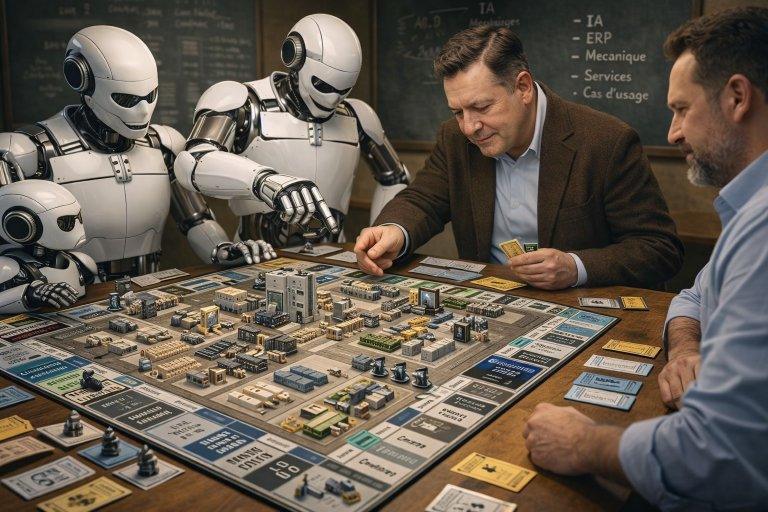
AI will become established in industry through tangible use cases. ERP/MRP systems will have to evolve—with their inherent risks—or disappear.
My decades of experience in the software industry (simulation, CAD, ERP) have given me a clear perspective on the potential of AI in the mechanical engineering market. Furthermore, I have no stake in any ERP/MRP software vendors or AI companies. However, I possess extensive experience and explore AI use cases daily. I propose that we examine how AI can be effectively integrated into the various departments of a typical mechanical engineering company.
With decades of experience in the software industry (simulation, CAD, ERP), I have a pragmatic view of what AI can truly bring to the mechanical engineering sector. I represent neither an ERP/MRP vendor nor an AI player: my approach is independent and field-oriented. I explore concrete use cases daily and offer to identify, department by department, where AI is effectively integrated into an industrial company in this sector.
In the 1980s and 90s, computers became ubiquitous in businesses, eventually becoming indispensable. Then came the internet, business applications, and ERP/MRP software. Today, AI is presented as a "good Samaritan," supposedly simplifying the work of industrial teams—provided it is integrated methodically and managed rigorously.
Here is a non-exhaustive list of the potential impacts of AI on very small and small businesses, with examples of use cases:
Every level of a company can be impacted by AI. It's a revolution in progress: today's manufacturer will be nothing like tomorrow's. However, current industrial management tools—ERP and MRP—are based on outdated designs. AI will reshuffle the deck, to the point of rendering some solutions partially obsolete.
Unless I'm mistaken, no software publisher will escape this: these tools will need to be fundamentally redesigned to integrate AI into their workflows. This transformation carries major risks, both for publishers and for the companies that use them. Many of these tools have become behemoths: decades of R&D and patches, accumulated complexity that makes any structural evolution difficult, if not impossible (beyond cosmetic changes).
In practical terms, AI can be integrated into ERP/MRP systems in four ways:
I will return to these four trajectories, which are sure to generate a lot of discussion.
When I write, "all services can be impacted by AI," it doesn't mean we should overhaul the company's governance under the pretext that AI is essential to remain competitive. We must remain level-headed and prioritize what is truly useful.
Instead, ask yourself this question: What is your current challenge as an industrialist, and how could AI help you with a fast and measurable ROI?
An audit is often the best way to identify a few key processes that would benefit from automation via an AI agent.
Finally, here is a player who knows the industrial fabric of mechanics well and offers support for task automation:
https://www.linkedin.com/feed/update/urn:li:activity:7429436891701219328
In conclusion:
AI will transform all the services of an industrial SME, but success will depend on gradual, measured, and secure integration. Start with a few high-ROI automations targeting your pain points, then expand AI's involvement based on the results: a quick audit will help identify the best "quick wins" and chart a realistic course.
And you: in your business, what areas would you like to optimize or have you already optimized with AI support?