

Author of Science Fiction and Anticipation Novels
Author of Science Fiction and Anticipation Novels
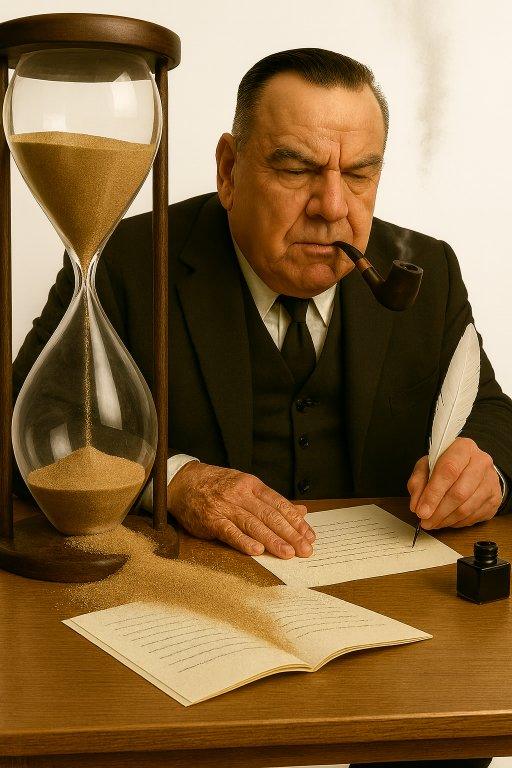
Robert — Let's talk about theinevitable destiny.
Laurent — Why does the subject interest you?
Robert — This is a central aspect of your writing project, which counterbalances the free will.
Laurent — Yes. I would put it this way: like two giants of the same force fighting without ever being separated.
Robert — I hear. But, in the end, there is a winner: theinevitable destiny.
Laurent — Indeed, at the end of all ends. But which one are we talking about? The one of theindividual which dilutes into that of the companies, themselves extended by that of thehumanity, and so on.
Robert — Have you ever had the impression... that we're moving forward, that we're turning off, that we're getting agitated - only to end up, despite everything, exactly where we were supposed to be?
Laurent — Yes, of course. It's even a sensation quite tenacious in me. As if, despite our choices, there were anchor points in our lives, kinds of essential milestones.
Robert — You're talking about the fate ?
Laurent — I don't know if that's the right word. It's not a external will, nor a plan drawn. Rather a kind of invisible logic…like a inner gravityWe think we're choosing, but sometimes I have the feeling that we're just going with the flow.
Robert — It's a bit of a thought dizzying.
Laurent — Dizzying, yes. But not necessarily. distressing. There is something consoling also. Knowing that everything does not depend on us is a way of lightening the weight of the fault.
Robert — And to absolve our responsibilities errors ?
Laurent — Not really. We're staying. responsible of the way, even if theissue escapes us. It is not because the END it is inevitable that the journey doesn't make sense.
Robert — You remind me of this sentence…heard somewhere, I don’t know where: “There is an infinity of paths to get to theinevitable. »
Laurent — Yes. It struck me too. It comes from the TV adaptation of Foundation, inspired by the novels by Isaac Asimov. Hari Seldon pronounces it, if I remember correctly.
Robert — He is the one who predicts the fall of the Galactic Empire, No ?
Laurent — Exactly. He invents a science, there psychohistory, which allows to model the behavior people on a large scale. He knows that theEmpire will collapse and that a dark ages is inevitable. But it builds a plan, a Foundation, to shorten the darkness. Not to avoid the fall — he knows that this is impossible — but to guide thehumanity through her.
Robert — So he accepts theinevitable but seeks to soften it outline.
Laurent — There you go. He doesn't deny the fate, he work. Like a sculptor with a rough stone : he cannot change matter, but he can orient the shapes. This is where the free will. He shapes the path which leads to theinevitable destiny.
Robert — It is both lucid and… profoundly human.
Laurent — This is, I think, what drives theman to move forward: thehope to be able to change one's destiny, even if it is probably only a illusion. I think that's what I like most about this idea. She reminds us that between the chance and the fatality, there is a space — tiny perhaps, but real — for the will.