


Author of Science Fiction and Anticipation Novels
Author of Science Fiction and Anticipation Novels
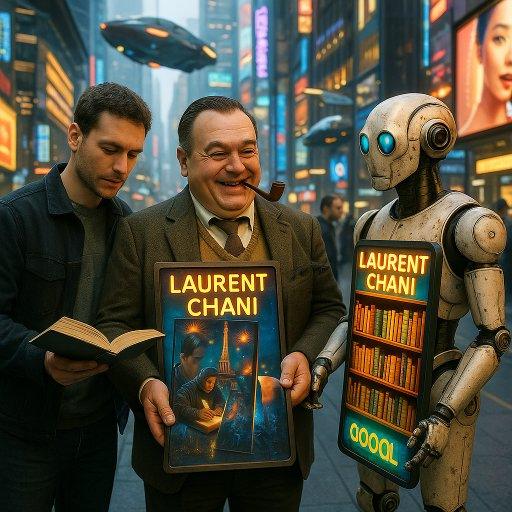
It is said that in almost every home, a manuscript lies dormant in a drawer. The desire to leave a written record of one's time on Earth is deeply ingrained in us, even if, in our time, we are less and less inclined to recount an experience, a dream, to keep a diary, or to commit to paper the stories that spring from our imagination. It took me decades to commit myself concretely to this path.
What are we looking for when we write? To recount our experiences for ourselves? In that case, a personal diary is perfect, especially if it's protected by a small lock. But sooner or later, a deeper desire emerges: to tell a fictional story, sometimes inspired by real events, and to see it read by others.
This is where publishing comes in. Until you've faced it, you don't truly grasp what it entails. You convince yourself that your story will inevitably interest a publisher because, obviously, your work is "unique." We readily quote the phrase attributed to Thomas Edison: "Genius is one percent inspiration and ninety-nine percent perspiration." We also echo Olivier Descosse's formula: "Writing is 10% talent and 90% work," sometimes attributed to Picasso for art in general. For my part, I've always had a variation in mind: "Art is 10% creativity and 90% elbow grease," perhaps inherited from my father. Regardless of its origin, in my eyes, it's an undeniable truth.
Unfortunately, simply pouring all your energy into a work doesn't guarantee it will captivate the masses. You still need to make yourself known, and above all, gain access to the right networks. How many aspiring authors say they've sent their manuscript to dozens of publishing houses without receiving even a simple word of thanks for work that took months, years, sometimes a lifetime?
Today, even though writing and distribution are facilitated by digital files, publishing is no simpler. It must be admitted that the path from printed document to book on a bookseller's shelf is particularly arduous. Those who succeed are few and far between. Among the reasons I know of are: typos, grammatical errors, overwhelmed reading committees, publishing houses' editorial strategies, proofreaders, typographers, graphic designers, marketing, distribution, prominent placement in stores, distribution networks… not to mention cronyism, reputation, and social media presence. It's a whole machine whose complexity and financial, as well as administrative, burdens are not immediately apparent.
It is therefore inevitable that those who persevere and want to see their project through will wonder if it's really worth the effort. Nothing is less certain. Before embarking on this path, one should ask a simple question: is it reasonable to invest so much energy for such an uncertain outcome? I almost forgot the case of publishers who offer "self-publishing," the ultimate trap where you pay out of pocket for the printing of books that, with a bit of luck, will end up on a shelf or in self-service format next to a supermarket checkout.
Yet, my ego has the audacity to think that every effort deserves a minimum of recognition, if not a salary. So what to do when one is aware of this tortuous path, leading to an often unattainable publishing Olympus?
Self-publishing is emerging as a modern solution, particularly relevant if you have the time and don't want to invest your hard-earned money. It's a way to see your project through to the end, to feel that you've tried everything to achieve your goal, however illusory, and, incidentally, to thumb your nose at the book industry, which is only truly interested in a select few.
The challenge is significant. We embark alone on an arduous path and will have to accomplish, without professional help, all the tasks involved in the world of publishing and distributing books or other works, because the rule remains the same.
And if success awaits you at the end of the road, you'll owe it to no one else. And if not, you can at least tell yourself that you put all your determination into getting there. It's sometimes said that it's the journey that matters, not just the destination. In any case, everyone has a chance—however slim.
A new world opens up before you. But this world resembles an obstacle course whose rules you don't yet know. One thing is certain: it will be fraught with pitfalls, false traps, bitter disappointments, and signs that read "Stop" or "Give up, it's not for you." It's a safe bet that those around you won't be of much help, having no more knowledge in this area than you do. Sometimes, they'll be reluctant to support you because your endeavor will be seen as just another whim. Another apt saying: God helps those who help themselves. You'll need to cultivate an almost mystical faith in this mission, because the tunnel you're embarking on is far from a pleasant journey.
Fortunately, you have an ace up your sleeve. Your best ally right now is undoubtedly an AI that will reassure you, show you the way, and even be an invaluable assistant. It will tell you that there are thousands of people, just like you, who have embarked on self-publishing. The National Library of France states that more than 201,000 official publications in France are self-published.
So, why not you?
And what about the author in all of this?
In my case, this choice of self-publishing isn't theoretical: it's already embodied in my current project with a strategy I'm refining. I'll regularly revisit it on this site to share progress, behind-the-scenes glimpses, and the lessons I'm learning.