


Author of Science Fiction and Anticipation Novels
Author of Science Fiction and Anticipation Novels
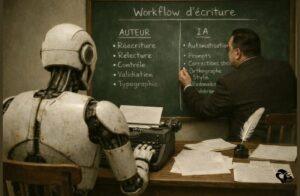
Generative AI has changed the way we correct and improve a text. But for a novel, the real challenge isn't "having the best prompt": it's building a reliable workflow, traceable and compatible with the author's voice. This article summarizes the best practices observed online (tools, methods, safeguards) and proposes a reproducible approach.
1) The turning point: from “magic prompt” to “process”
On the internet, you can find hundreds of proofreading prompts. Most fail for one simple reason: they mix everything up (spelling, style, rewriting, consistency) in one pass. The result: the text becomes “clean,” but often standardized. For a novel, the priority is the opposite: preserve the intention, and only automate what is controllable.
2) The prevailing model: a chain in passes
The state of the art converges towards a chain in modules, From the most objective to the most subjective:
That's the difference between "using AI" and industrialize quality.
3) Safeguard #1: “zero reformulation” when you want control
The most profitable prompt for a novelist is often… the most restrictive:
“Correct only what is objectively wrong. Do not rephrase. Maintain rhythm and voice. Return a LOG of corrections.”
This type of prompt limits creative drift and makes the result auditable.
4) Traceability: the professional database (Word, Track Changes, Compare)
Effective workflows rely on:
5) Confidentiality: work with extracts (and anonymize if necessary)
A novel can contain sensitive elements (people, places, emails, private facts). The most robust practice:
6) High-end orthotypography: the finishing touch that makes all the difference
After linguistic correction, the typographic finishing touches make the "editing":
7) Benchmark: how to know if a prompt is really good
The state of the art “pro” uses a stable test suite : 10 typical extracts (dialogue, action, description, technical passage, emotion, etc.). We run different prompts/tools on the same extracts, then we take notes:
8) Three prompt templates (ready to adapt)
A — Strict correction (objective)
“You are a proofreader. Only correct French spelling/grammar/punctuation/typography. Do not rewrite. Preserve paragraphs and rhythm. Output: corrected text + LOG (error → correction → category).”
B — Consistency audit (without rewriting)
“You are a consistency reviewer. List of vague references, local contradictions, variants of names/objects/units. Do not rewrite. Output: table (problem → extract → minimal correction).”
C — Controlled polishing (risk managed)
“Improves fluency without changing the voice. Prohibited: changing meaning, adding information, standardizing style. Limit: max 10% of modified sentences. Output: text + list of modified sentences.”
Conclusion: true maturity lies in method
Yes, the internet is full of prompts. But for a novelist, maturity lies in transforming those ideas into production line Modularity, logs, validation, custom style, confidentiality, benchmarking. AI then becomes what it should be: a time multiplier… without stealing your voice.